
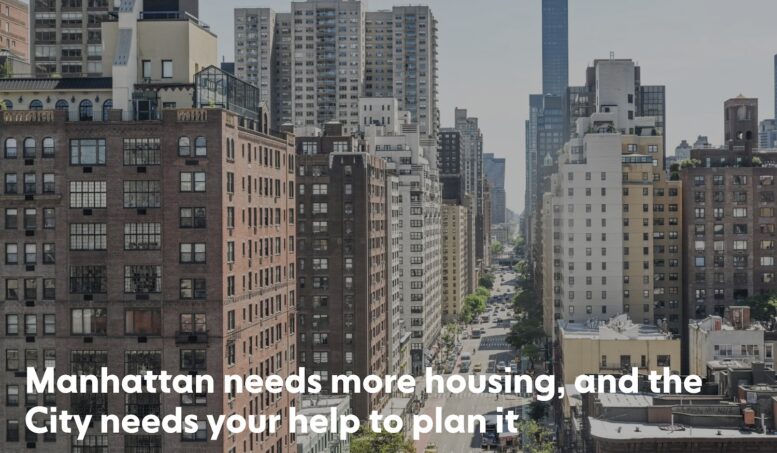
New York City Mayor Eric Adams and New York City Department of City Planning Director Dan Garodnick have released the “Manhattan Plan,” a borough-wide housing framework aimed at adding 100,000 new homes in Manhattan over the next decade. The plan was first announced during the mayor’s 2025 State of the City address and is positioned as a response to long-standing declines in housing production and affordability in Manhattan, despite the borough’s concentration of jobs, transit access, and infrastructure.
The Manhattan Plan outlines multiple strategies to increase housing supply, including building more housing near major transit corridors and job centers, expanding development in areas with lower housing production, and advancing office-to-residential conversions. The framework also emphasizes the redevelopment of city- and government-owned properties, such as 100 Gold Street in Lower Manhattan, which is planned to be transformed into a mixed-use tower with approximately 3,700 apartments, at least 25 percent of which would be permanently affordable.
Additional strategies include zoning and regulatory changes to enable higher-density residential development in select areas, particularly through the use of newly established high-density zoning districts. The plan also highlights the need to streamline the development process, reduce regulatory barriers, and expand alternative housing models such as Housing Development Fund Corporation cooperatives, Mitchell-Lama developments, and community land trusts to support long-term affordability.
The plan was shaped by an extensive public engagement process that gathered more than 2,500 ideas through community district events, surveys, and an interactive mapping platform. City officials note that nearly half of Manhattan residents are currently rent-burdened, with a significant portion spending more than half of their income on housing, underscoring the plan’s focus on increasing supply across income levels.
Subscribe to YIMBY’s daily e-mail

Follow YIMBYgram for real-time photo updates
Like YIMBY on Facebook
Follow YIMBY’s Twitter for the latest in YIMBYnews




Why does everyone have to live in Manhattan? That is the high rent district and if you cannot afford it, you live in an outer borough. It is not the kiss of death not to live in Manhattan.
You need to break rampant NIMBYism to get much done in the outer boroughs. There are areas around subway and LIRR/MetroNorth stations that could & should be zoned for 8 – 12 stories and can’t be.
Overcome that and you’re home free.
Until then, build where you can.
In Manhattan, people pay 2 – 8 million for condos within a block of NYCHA buildings. In outer boros? Not so much.
Because Manhattan has billions of dollars of underlying infrastructure and can still support higher density.
Adams is past tense. Let’s hope he moves to Israel. lol
Maybe Adams will move to Florida. The irony.
Simple solution, build more “SRO’s”, (Single Room Occupancy), Manhattan used to have them, but do them better, “tiny homes”, but “vertically integrated”, studio efficiencies, etc, but well designed, practical, not “squalor”, but not “billionaire’s row” either, the 860 ft tower on 292 5th Ave, which only yields 26 “safety deposit boxes” in the sky for foreign elites, who won’t even occupy them, could have yielded approximately 1,200 SRO’s in the same space as 26 luxury units, & this is just one idea/ solution.
Manhattan currently has plenty of SROs, so you’re gonna have to call what you’re talking about something else. Whatever it used to connote, it now mostly refers spaces id describe as a shabby single room with varying degrees of security (some literally have no locks on the doors), no storage and shared bathroom and kitchen spaces. If you’re thinking it’s a place for you g professionals think again. Staff in these places treat them like prisons in terms of attitudes toward people who live there. Some have curfews, guests are rarely allowed even among building residents, and the “shared” spaces are in no way private meaning you can’t really keep your food or bathroom items there because they will be stolen or thrown out. Some literally have no way to prepare food except perhaps a single microwave. And as they currently are, they’re dangerous and insecure places to live with questionable hearing and probably no cooling in the summer at all.
I know you’re thinking of something else, but the term SRO has been tainted by what they represent which is bare-minimum shabby temporary housing given to people in crisis, such as transitioning from homelessness to “affordable” subsidized housing. People are expected to be there a maximum of 6 months, though in practice some people basically permanently stay there. They’re run by a variety of organizations, and while some no doubt provide services or benign neglect, not a few are completely corrupt mechanisms for transfers of public money to private hands of the operators, some of whom seem to intentionally hinder transition away because a known harmless resident is more profitable than the potential new tenant with whatever issues that tenant, I’m sorry, not “tenant” but “resident” brings. Officially you may be called a tenant but you are at most treated as a resident and that distinction matters You hold hold no stake (as tenants do), you just reside there in a atmosphere designed to keep you from realizing your rights are not guaranteed.
I’ve gone off on a bit of a tangent, but the term SRO has way too much baggage for too many people to ever be successfully used in this city. Any system that is set up using that term will be fighting against the terms history for no good reason. My visceral reaction to your suggestion is dread and revulsion even though I know what sort of place you’re referring to. SROs the way they’re set up now treat housing as a criminal justice issue, not an economic one. There is no need to treat people who have committed no crimes under a criminal justice mindset unless you view poverty as a crime to be punished.
Affordable housing development and incentives to have businesses need to be spread out to the low density outer boroughs, along commercial corridors that have transit. NYC should no longer be thought of as an area with only one business district. Each borough should be developing live/work/play areas to decentralize the business districts. One flaw with the “Fair Housing Plan” is that it doesn’t take into consideration existing affordable housing, only “new” affordable housing. Often the incentives for new affordable housing result in tearing down older, smaller buildings that have rent stabilized apartments to build tall luxury apartment buildings with a net LOSS in truly affordable apartments. This has happened in many Manhattan neighborhoods. The details of the zoning changes are important. A requirement for truly affordable housing has been lacking.